
Mecklenburg County Probate Case Lookup
Mecklenburg County probate court records are maintained by the Clerk of Superior Court in Charlotte. As the second most populous county in North Carolina with over 1.2 million residents, Mecklenburg County handles a large volume of estate cases each year. The Estates Division processes wills, estate filings, guardianships, and related matters. Searching for probate court records is available online through the county portal and in person at the courthouse. Whether you need to find a will or check the status of an estate case, the clerk's office in Charlotte provides access to these public records.
Mecklenburg County Quick Facts
Mecklenburg County Estates Division
The Mecklenburg County Clerk of Superior Court is Elisa Chinn-Gary, who serves as the judge of probate for the county. The Estates Division is located in Suite 3720 at 832 East Fourth Street in Charlotte. This office handles all probate court records including wills, estate administration, guardianships, adoptions, incompetency proceedings, and foreclosures. Clerk Chinn-Gary oversees a staff that processes thousands of estate cases each year for Mecklenburg County residents.
Mecklenburg County was created on November 3, 1762 from Anson County. It was named after Charlotte of Mecklenburg-Strelitz, the queen consort of George III. The county seat is Charlotte, the largest city in North Carolina. The Estates Division manages probate court records for all municipalities within the county, including Charlotte, Huntersville, Cornelius, Davidson, Matthews, Mint Hill, and Pineville. Every estate case in the county goes through this one office.
You can reach the Estates Division by email at Mecklenburg.Estates@nccourts.org for questions about estate and special proceedings filings. The mailing address for document submissions is PO Box 37971, Charlotte, NC 28237-7971. Phone inquiries go to the main courthouse number.
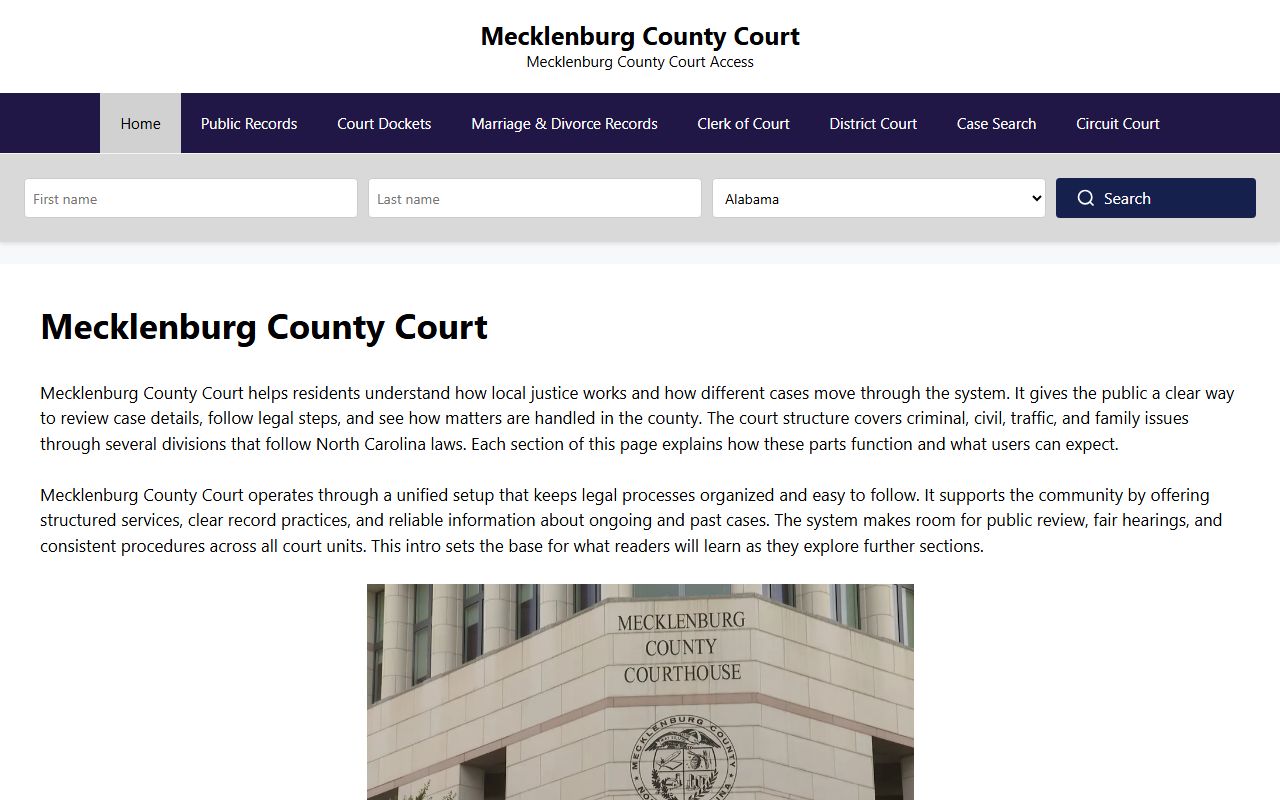
The Mecklenburg County courthouse website provides current details on probate court records and estate procedures.
| Court |
Mecklenburg County Clerk of Superior Court Estates Division, Suite 3720 832 East Fourth Street Charlotte, NC 28202 Phone: (704) 686-0400 Mailing: PO Box 37971, Charlotte, NC 28237-7971 |
|---|---|
| Hours | Monday through Friday, 8:30 AM to 5:00 PM |
| Mecklenburg.Estates@nccourts.org | |
| Website | nccourts.gov/locations/mecklenburg-county |
Searching Mecklenburg Probate Court Records
Mecklenburg County offers an online portal for searching probate court records. The Tyler Technologies portal at portal-nc.tylertech.cloud lets you look up estate cases by party name or case number. Basic case information is free to view. This is the fastest way to check the status of a probate case or find a filing in Mecklenburg County without leaving home.
There is one important limit to know. Cases created before October 9, 2023, may not appear in the online portal. If you are looking for an older estate case, you may need to contact the Estates Division directly or visit the courthouse in person. Send an email to Mecklenburg.Estates@nccourts.org to request information on older probate court records.
For in-person searches, go to Suite 3720 at 832 East Fourth Street in Charlotte. Staff can look up cases and provide copies of probate court records on the spot. Bring a valid photo ID. Certified copies cost approximately $5 each. Plain copies cost less.
Note: The Mecklenburg County Estates Division handles a high volume of cases. Calling ahead or emailing before your visit can save time.
To find probate court records in Mecklenburg County, you need:
- Full legal name of the deceased person
- Date of death or approximate year
- Case number if available
Estate Filing Process in Mecklenburg County
Filing an estate case in Mecklenburg County starts at the Estates Division in Suite 3720. You bring the original will, a certified death certificate, and information about the deceased person's assets. The clerk reviews your documents and determines the type of administration needed. If there is a will, you file Form AOC-E-201, the Application for Probate and Letters Testamentary. If there is no will, the clerk guides you through the intestate process.
The personal representative must appear in person at the Mecklenburg County courthouse to take the oath of office. Once qualified, the clerk issues letters testamentary or letters of administration. These letters give the representative legal authority to act on behalf of the estate. The representative must then publish a Notice to Creditors in a Charlotte newspaper once a week for four consecutive weeks. Creditors have 90 days from the first publication to file claims.
Within 90 days of qualifying, the representative must file an inventory of all estate assets with the Mecklenburg County clerk. This inventory lists every asset and its fair market value at the date of death. Annual accounts must be filed showing all income received and expenses paid by the estate. These filings become part of the probate court records kept by the Estates Division.
North Carolina allows a surviving spouse to petition for a Year's Allowance of $60,000. This claim has priority over all others except administration costs. A surviving spouse may also elect to take a share of the estate under N.C.G.S. 30-3.1, ranging from 3% to 50% depending on the length of the marriage. The election must be filed within six months of the personal representative's qualification in Mecklenburg County.
Mecklenburg County Probate Fees
Mecklenburg County uses the statewide fee schedule set by North Carolina General Statutes. The Clerk of Superior Court collects these fees when you open an estate or request copies of probate court records. Fees can change, so confirm the current amounts with the Estates Division before filing.
Standard fees for probate court records and estate matters in Mecklenburg County:
- Application to open an estate: $120
- Estate administration fee: 0.4% of probate value, capped at $6,000
- Certified copies of letters: approximately $5 per copy
- Notice to Creditors publication: $50 to $150
- Bond premium: varies by estate value
Unless the will specifically waives the bond, the personal representative must post bond in Mecklenburg County. Surety companies charge 0.5% to 1% of the bond amount per year. North Carolina allows the personal representative to receive compensation of up to 5% of the estate's receipts and disbursements. The clerk decides the exact amount if beneficiaries disagree. Low-income filers may request a fee waiver through a Petition to Proceed as an Indigent.
Small Estate Options in Mecklenburg County
Mecklenburg County residents with modest estates may qualify for a simplified process. The Collection by Affidavit method lets heirs collect personal property without opening full probate. This creates fewer probate court records and costs less than formal administration.
You may use this option in Mecklenburg County when the deceased person's personal property is $20,000 or less. If the applicant is the surviving spouse and sole heir, the cap rises to $30,000. At least 30 days must pass after the date of death before you can file. The affidavit does not work if real property must be sold within two years. File the small estate affidavit using Form AOC-E-203B at the Estates Division in Suite 3720.
Note: You still need a certified death certificate, the original will if one exists, an itemized asset list, a photo ID, and the $120 filing fee when using the small estate affidavit in Mecklenburg County.
Historical Estate Records in Mecklenburg
Mecklenburg County has a long history of record keeping. The Register of Deeds holds birth and death records from 1913, marriage records from 1850, and land records from 1763. The Clerk of Superior Court has divorce, probate, and court records from 1930. Older probate court records before 1930 may be available through the North Carolina State Archives in Raleigh.
The county was formed in 1762 from Anson County, making it one of the older counties in the state. Named after Queen Charlotte of Mecklenburg-Strelitz, the county has grown from a small colonial settlement to the most populous urban area in North Carolina. The probate court records from its early decades reflect the agricultural and trading economy of the colonial and antebellum periods. Researchers looking for estate inventories, wills, and administration bonds from the 1700s and 1800s should contact the State Archives at archives.ncdcr.gov for microfilm and original documents.
Mecklenburg County covers 546 square miles. Charlotte serves as the county seat and the hub of all court activity. With a population of over 1.2 million, the county processes one of the highest volumes of probate court records in the state each year.
Browse Nearby Counties
These counties surround Mecklenburg County. If the deceased person lived near a county line, confirm which county they were domiciled in at the time of death. Probate court records must be filed in the correct county for the clerk to have jurisdiction.